
Personalized Song Canvas vs Printable Art - Which Is Better in 2026?

By the AmourPrint editorial team · Last updated May 28, 2026 · ~1,950 words
For an anniversary gift, a personalized song canvas almost always beats a printable digital download — not because printables are bad, but because the gift moment, the display permanence, and the substrate quality differences add up to a meaningfully different experience for the recipient, and the cost gap (typically $40 to $60 once the buyer accounts for the printing and framing required to make a printable display-ready) is much smaller than the listing prices suggest.
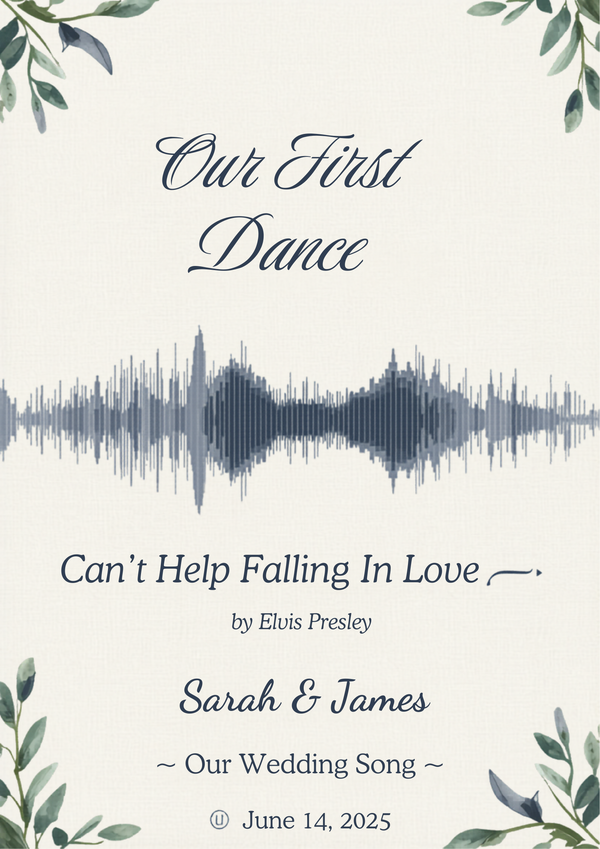
The printable art category exploded between 2020 and 2025, driven by Etsy, Canva, and a wave of independent designers offering instant-download personalized files for a fraction of the price of finished canvas. The pitch is appealing: pay $5 to $25, get a high-resolution PDF, print it yourself or at a local print shop, frame it, and you have a custom anniversary gift for under $40 total. For some use cases this works well. For anniversary gifts specifically, the math is more complicated than the listing prices suggest, and the experience gap is larger than the price gap.
This guide compares personalized song canvas and printable art head-to-head across the dimensions that matter for an anniversary gift: total cost (not just the digital file price), display permanence, gift-moment quality, customization depth, and what happens when something goes wrong. The comparison is deliberately fair to both formats — there are situations where printable art is the right answer, and the section below names them — but the conclusion for most anniversary gift buyers is unambiguous.
The total cost of "cheap" printable art
The headline price of a printable design is the digital file itself, typically $5 to $25. The actual total cost to display the file on a wall is significantly higher, and the listing pages rarely break it down. Walking through the real math for an 11x14 framed display:
The digital file is $15 on average. Printing the file at a quality level appropriate for gifting requires either a home photo printer (which most households don't own at the required quality) or a print shop. Local print shops charge $10 to $25 for an 11x14 archival print on heavy paper. Online print services in the same range. A frame appropriate for an anniversary gift (not a $5 plastic dollar-store frame) runs $30 to $80 for a quality wood frame with a mat. Matting itself adds $10 to $20 if not included with the frame.
Adding those up: $15 file plus $20 print plus $50 frame and mat equals $85 total cost for an 11x14 framed printable. That total is in the same range as a finished 12x16 personalized song canvas from a quality studio, which typically runs $50 to $90 fully delivered. The price gap that printable art appears to offer often disappears once the buyer accounts for the costs the listing didn't include.
The math gets worse at larger sizes. A 16x20 printable requires more expensive printing ($25 to $45), a much more expensive frame ($75 to $150), and often professional framing services for accurate cut and mounting ($30 to $60 in labor). A 16x20 personalized song canvas in the same format runs $75 to $130 delivered. The printable can easily exceed the finished canvas in total cost while requiring three weeks of buyer effort to complete.
Display permanence and substrate quality
The second comparison dimension is how the piece holds up over a decade of display. This is where the substrate differences become decisive.
A printable printed on standard cardstock and framed under standard glass will fade noticeably within 5 to 8 years under typical household lighting, and faster under direct sunlight exposure. Upgrading to archival paper and UV-filtering museum glass extends the lifespan to 30+ years but adds another $40 to $80 to the framing cost. Most printable buyers don't make this upgrade because the listing didn't suggest it, which means the typical printable in a home environment shows visible fading by the 10th anniversary — the exact milestone the gift was meant to commemorate.
A quality personalized song canvas uses pigment inks on cotton-poly or cotton canvas, with the print sealed against UV and moisture. Fade lifespan is 75 to 100+ years under typical household conditions, with no separate framing required (the canvas wraps around its own integrated wood frame). The substrate is engineered to last the marriage, which is the relevant timescale for an anniversary gift.
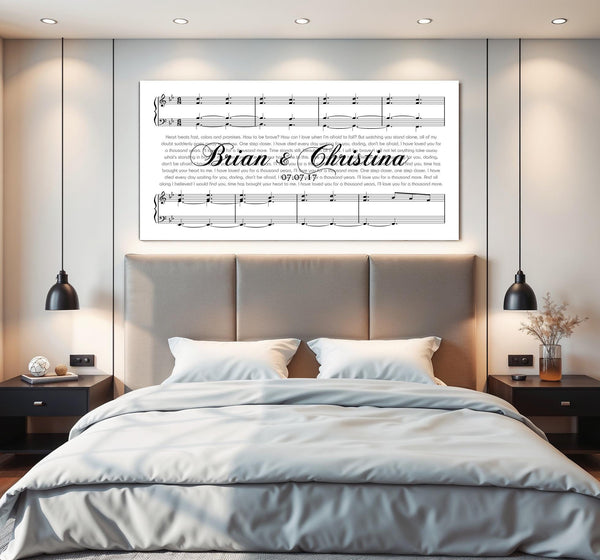
The visual difference between canvas and framed paper print is also worth naming. Canvas has a textured surface that catches light and gives the print depth; framed paper sits flat under glass with reflections at certain angles. Both can be beautiful, but the canvas reads as more substantial — closer to a piece of fine art than to a document. For an anniversary gift specifically, the substantial feel matters.
The gift-moment experience
This dimension is the one most often overlooked in cost comparisons. The moment when the recipient opens the gift is part of the gift itself, and the formats produce very different experiences.
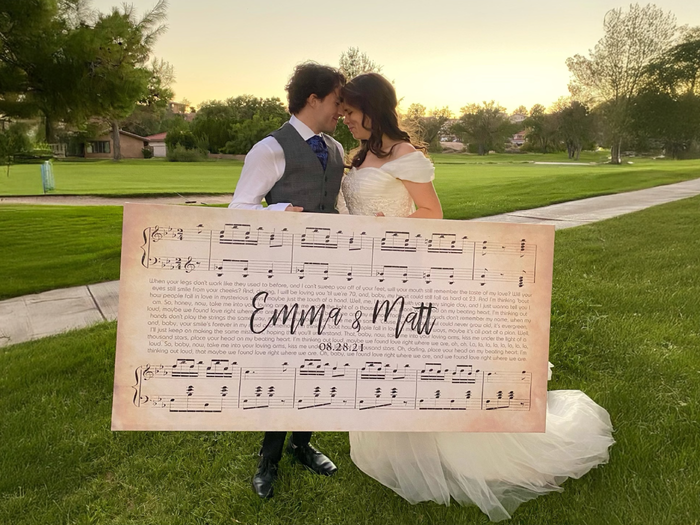
A finished canvas arrives in a single package, wrapped, ready to display. The recipient opens it once, sees the completed piece, and the moment is contained. The substrate, the framing, the typography all work together at the reveal.
A printable, in contrast, requires the buyer to deliver multiple pieces to complete the gift. If the buyer prints and frames the file before giving it, the experience approaches a canvas gift. If the buyer hands over a USB stick or printout of the file with a note saying "print this however you want," the experience falls apart — the recipient now has homework instead of a gift, and the homework involves choosing print shops, frames, and matting in a way that may not match the buyer's intent.
Most printable buyers fall between these two extremes — they print the file but skip the framing, or they buy a cheap frame to deliver the gift in display-ready form. Both compromises show, and neither produces the gift-moment quality that a finished canvas does.
Customization depth and design quality
The fourth dimension is how customizable the design actually is, and how good the design work tends to be.
Printable designs are usually template-based. The buyer selects a template from the designer's collection, fills in personalization fields (names, date, song lyric), and the designer's automation fills the values into the existing template. This works fine for simple personalization, but it constrains the design to what the template supports. Layout changes, font swaps, color palette adjustments, and substantive customization are usually not available, or are available as upcharges that erode the price advantage further.
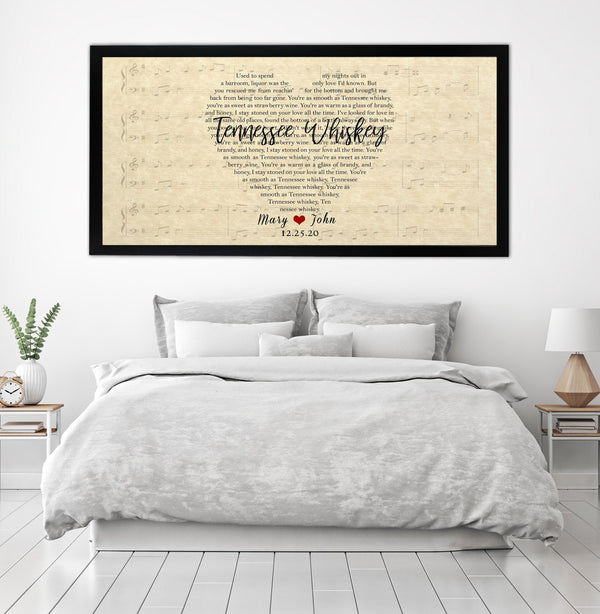
Quality canvas studios typically work the other direction — the buyer submits the personalization, and the studio's design team builds a layout around it. This allows for adjustments based on the specific content (a long lyric needs different typography than a short one), the recipient's taste (different color palettes for different rooms), and the buyer's preferences (more or less ornamentation, different background tones). The design quality differential shows in the final piece.
One important exception: a few printable designers do offer custom layout work for premium prices ($50 to $200 for true bespoke design). At that price point, the cost advantage versus canvas mostly disappears, but the design quality can match canvas studios. These designers tend to identify themselves clearly in their listings as custom-design rather than template.
When printable art is the right answer
Despite the comparisons above, several scenarios genuinely favor printable art. Naming them honestly:
- Wedding signage and decor. Welcome signs, seating charts, and ceremony programs are explicitly temporary and don't need to survive a decade. The printable model fits the use case perfectly.
- Test prints before committing to canvas. Some buyers print a draft of the design at home before ordering the canvas to make sure the layout works in the intended room. This is a smart use of printable as a preview tool.
- Multiple recipients of the same design. A printable that will be sent to several family members (anniversary cards for parents, a quote for a friend group, etc.) makes sense when the unit economics of producing multiple canvases don't.
- Highly DIY-comfortable recipients. If the recipient enjoys the printing and framing process — some people genuinely do — a printable can be a thoughtful gift that engages their interest rather than an inconvenience.
- Last-minute digital sends. A printable can arrive instantly via email, which fills a real gap when a gift was forgotten and the anniversary is tomorrow. The follow-up canvas can ship the following week as a complete version.
Outside of these scenarios, the finished canvas is almost always the stronger choice for an anniversary gift.
How to choose between formats for your specific situation
The decision tree is short. If the gift is for a milestone anniversary (first, fifth, tenth, twenty-fifth, fiftieth) and intended to be displayed long-term, choose the finished canvas. If the gift is for a temporary use case, multiple recipients, or a DIY-comfortable recipient, the printable can work. If you have more than seven days of runway, the canvas is logistically straightforward; if you have fewer than two days, the printable may be your only option.
One pragmatic middle path: send a printable digital file as the immediate "gift in time for the day" gesture, with a note saying the finished canvas will arrive the following week. This combines the no-deadline reliability of digital with the finished-piece quality of canvas, and the moment of unwrapping the actual canvas a week later becomes a second gift-moment.
Frequently asked questions
Q: Is personalized song canvas really worth the price difference over printable art?
A: For anniversary gifts specifically, yes. The actual price difference (after accounting for printing and framing costs to make a printable display-ready) is typically $40 to $60, not the $40 to $80 the listing prices imply. And the experience, longevity, and gift-moment differences justify that gap easily.
Q: Can printable art ever look as good as a finished canvas?
A: Yes, but only when the buyer prints on archival paper at a quality print shop, frames in a quality wood frame with UV-filtering glass, and uses a designer who does custom layout work rather than template fill. By the time all of those upgrades are added, the cost is similar to a finished canvas with less convenience.
Q: How long does a typical home-printed printable last before fading?
A: A standard cardstock print under standard glass shows visible fading within 5 to 8 years under typical indoor lighting, and within 2 to 3 years under direct sunlight. Archival paper and UV-filtering glass extend this to 30+ years but add significant cost to the total project.
Q: When does it actually make sense to choose a printable over a canvas?
A: Wedding signage and decor (temporary use), multiple recipients of the same design, highly DIY-comfortable recipients who enjoy the printing process, and last-minute situations where the canvas can't arrive in time. For long-term display gifts for a single recipient, canvas almost always wins.
About AmourPrint
AmourPrint is a family-owned personalized canvas studio based in Victorville, California. We specialize in song-lyric canvases for weddings, anniversaries, and meaningful life moments, with 4,600+ verified reviews at 4.96★. Lyrics are licensed per order through Musixmatch. Read our customer reviews.