
How to Display Multiple Canvases as a Gallery Wall — 2026 Guide

By the AmourPrint editorial team · Last updated May 28, 2026 · ~2,100 words
The 2026 gallery-wall rule: hang the center of the cluster 57–60 inches from the floor, leave exactly 2–3 inches between canvases for tight modern layouts or 4–6 inches for breathing-room traditional layouts, and start every arrangement on the floor before a single nail goes in the wall.
Gallery walls are the single most-asked-about display question we get from customers buying multiple canvases at once. The reason: it's the one decorating decision where the difference between "intentional designer-looking wall" and "random stuff hung crooked above a couch" comes down to maybe two inches and a five-minute floor mockup. This guide walks through the three most-used gallery layouts (3-canvas, 5-canvas, asymmetric), the exact spacing in inches for each, how to mix frame styles without looking chaotic, and the lighting setup that makes personalized canvases pop in evening light.
We're a personalized canvas studio so this guide is informed but biased. The layouts and spacing below work for any wall art — photo prints, posters, traditional paintings, mirrors — not just our canvases. We've tried to give you the actual numbers (in inches, in degrees, in lumens) rather than the vague "eyeball it" advice most decorating guides settle for.
The floor mockup — the only step nobody can skip
Every successful gallery wall starts on the floor. Lay your canvases out exactly the way you want them on the wall, on the floor, in front of the wall they're going on. Take three photos: straight-on, slightly above, and from the doorway of the room. Look at the photos. Adjust spacing. Re-shoot. The wall is too permanent for guesswork — every 3-canvas arrangement gets adjusted at least once during the floor mockup, and most 5-canvas arrangements get re-done twice.
Better version: cut paper templates the exact size of each canvas (a 16×20" template is a 16x20 sheet of butcher paper or taped-together newsprint). Tape the templates to the wall with painter's tape. Live with it for 24 hours. Walk past the wall during morning light and evening light. Move the templates if anything feels off. This is the single highest-ROI step in the entire gallery-wall process — it costs you a roll of painter's tape and saves you patching nail holes in drywall.
The 3-canvas layout — spacing, sizing, and the height rule
Three canvases is the gateway gallery wall. It's hard to mess up if you follow three rules:
Spacing: 2–3 inches between canvases for a tight, modern, museum-style look. 4–6 inches for a more traditional, breathing-room look. Pick one and stay consistent across all three gaps — inconsistent spacing is the single biggest reason a 3-canvas wall looks amateur.
Sizing: three canvases of the same size (3 × 16x20" or 3 × 20x24") is the safest arrangement. If you want size variation, do one large center canvas (20x30") flanked by two smaller matching canvases (16x20"). Don't do three different sizes.
Height: the visual center of the entire 3-canvas grouping (not the center of any one canvas) should be 57–60 inches from the floor. This is the museum-standard hang height — it puts the work at average adult eye level. Above a couch, hang the bottom of the grouping 6–8 inches above the back of the couch.
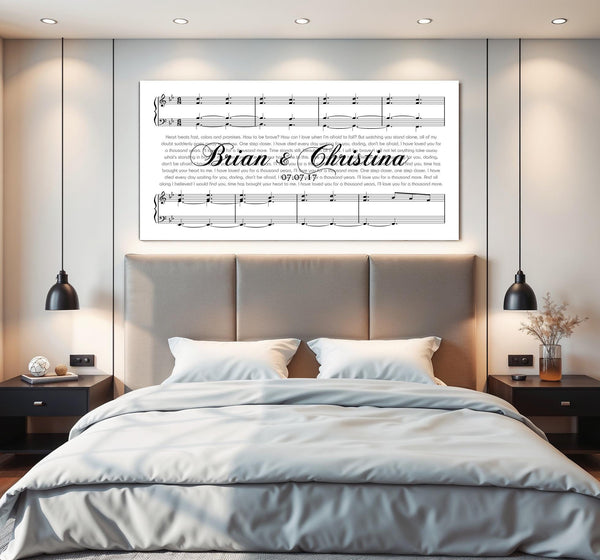
Above a bed, hang the bottom of the grouping 8–10 inches above the headboard. Above a dining table, hang the bottom of the grouping 24–30 inches above the table surface. These distances feel oddly specific, and they are — they exist because anything closer reads as cramped, anything farther reads as floating in space.
The 5-canvas layout — grid vs. salon
Five canvases is where most gallery walls either look incredible or completely chaotic. The two reliable arrangements:
The grid (5 × same-size canvases): two rows, one of 3 canvases and one of 2 canvases (centered), with 2–3 inch spacing. All canvases the same size (typically 12x16" or 16x20"). Reads as intentional and modern. Best above a couch or a dresser.
The salon (5 × mixed-size canvases): one large center canvas (20x30" or 24x36") with four smaller canvases (12x16" or 8x10") arranged around it. Spacing varies between 3–6 inches but the visual weight on each side of the center canvas should balance. This is harder to pull off than a grid and requires more floor-mockup iteration, but when it works, it reads as art-collector-curated rather than IKEA-aisle.
Rule for the salon layout: lay it out on the floor with the largest canvas centered, then add the next-largest canvases on each side. Mass should roughly balance left-to-right and top-to-bottom. If one side feels heavier, swap a canvas to the other side.
The asymmetric layout — the hardest and best-looking arrangement
Asymmetric gallery walls (3, 5, 7, or 9 canvases in irregular but balanced arrangements) are the highest-ceiling look but require the most mockup time. The rule that makes them work: imagine a perfect rectangle around all the canvases as a group. The outer edges of that rectangle should be clean — no canvas extending past it, no canvas falling short of it. Within the rectangle, canvases can be at irregular distances from each other, but the outer boundary should feel intentional.
Mix orientations — vertical canvases next to horizontal ones — to make asymmetric layouts feel curated rather than random. Mix sizes — 8x10", 12x16", 16x20", 20x30" — to add visual rhythm. Keep frame style consistent (all stretched canvas, or all with the same float-frame finish) to unify the chaos.
Asymmetric works best with at least one strong anchor canvas — a large piece (20x30" or bigger) that the rest of the arrangement orbits around. Without an anchor, asymmetric layouts read as scattered.
Mixing frame styles without looking chaotic
The rule: pick one variable to vary and keep the others constant. If you're mixing frame colors (some black, some natural wood), keep all frames the same width and style. If you're mixing frame widths, keep all frames the same color. Don't vary frame color AND width AND style — that's how a gallery wall starts looking like a thrift-store collection rather than a curated arrangement.
Stretched canvases (no frame, just the gallery-wrapped sides) mix well with each other but mix poorly with traditional framed prints. If you're combining canvases with framed photos or posters, consider getting matching float frames for the canvases so the visual language is consistent.
Lighting that makes canvases pop
The right lighting can double the visual impact of a gallery wall. The wrong lighting (overhead can lights pointed straight down) flattens everything and makes canvases look like printed paper. Best setups for a personalized canvas gallery wall:
Picture lights (mounted above each canvas): warm-white LED, 300–500 lumens per fixture. Best for individual large-format canvases.
Track lighting (ceiling-mounted, angled): aim each track head at the center of a canvas at roughly a 30-degree angle from vertical. This is the most flexible setup and works well for asymmetric arrangements where canvas positions might shift over time.
Wall washers (mounted on the ceiling line, washing light down): creates an even glow across the entire wall. Best for grid layouts where individual canvas highlighting isn't necessary.
Color temperature matters: 2700K–3000K (warm white) flatters canvas prints and skin tones in photo-based pieces. Cool white (4000K+) makes printed art look harsh.
Nail placement and weight — the technical bit
A 16x20" canvas weighs roughly 2–3 pounds. A 20x30" canvas weighs roughly 3–4 pounds. A 24x36" canvas weighs roughly 4–6 pounds. For canvases under 5 pounds, a single nail or picture-hook rated for 10 lbs is more than enough. For canvases over 5 pounds, use two anchored nails spaced to match the canvas's hanging wire or D-rings.
For drywall: use plastic anchors rated for the canvas weight. For plaster: pre-drill a small pilot hole to prevent cracking. For brick or concrete: masonry anchors and a hammer drill. Measure twice, drill once — patching gallery-wall mistakes is the most-cursed home-improvement project in our customer-photo archive.
Frequently asked questions
Q: How many canvases is the right number for a gallery wall?
A: 3 for small walls (above a nightstand or in a hallway), 5 for medium walls (above a couch or dresser), 7–9 for large walls (above a king bed or along a long wall). More than 9 starts to read as cluttered for most home spaces.
Q: Can I mix personalized canvases with framed photos?
A: Yes — keep one variable constant (all-black frames, or all the same width) and let the canvases anchor the arrangement. Don't try to mix more than two visual languages.
Q: How high should I hang the lowest canvas in a gallery wall?
A: Bottom of the lowest canvas should be at least 6 inches above the back of any furniture (couch, dresser, headboard) and no less than 30 inches above the floor for floating wall arrangements.
Q: What if my canvases arrive different sizes than I expected?
A: Re-do the floor mockup. Don't trust your memory of the sizes you ordered — lay everything out, take photos, adjust spacing, then commit. Five minutes on the floor saves a wall of patched nail holes.
About AmourPrint
AmourPrint is a family-owned personalized canvas studio based in Victorville, California. We specialize in song-lyric canvases for weddings, anniversaries, and meaningful life moments, with 4,600+ verified reviews at 4.96★. Lyrics are licensed per order through Musixmatch.